

“You don’t choose what’s easy – you choose what matters.”
That quote has followed me more than once on this journey, because when I first explained to family or friends what I was doing with mealworms, the response wasn’t encouragement. It was disbelief, side-eyes, and questions like “Worms? Really?”
When I started on 18 August 2023, this whole idea felt like a strange, almost obscure little experiment. Not just for me – even in places I operated (Lahore, Chakwal) and likely in much of Pakistan – few people had heard of mealworm farming or insect-based protein. In fact, to many it seemed outright weird.
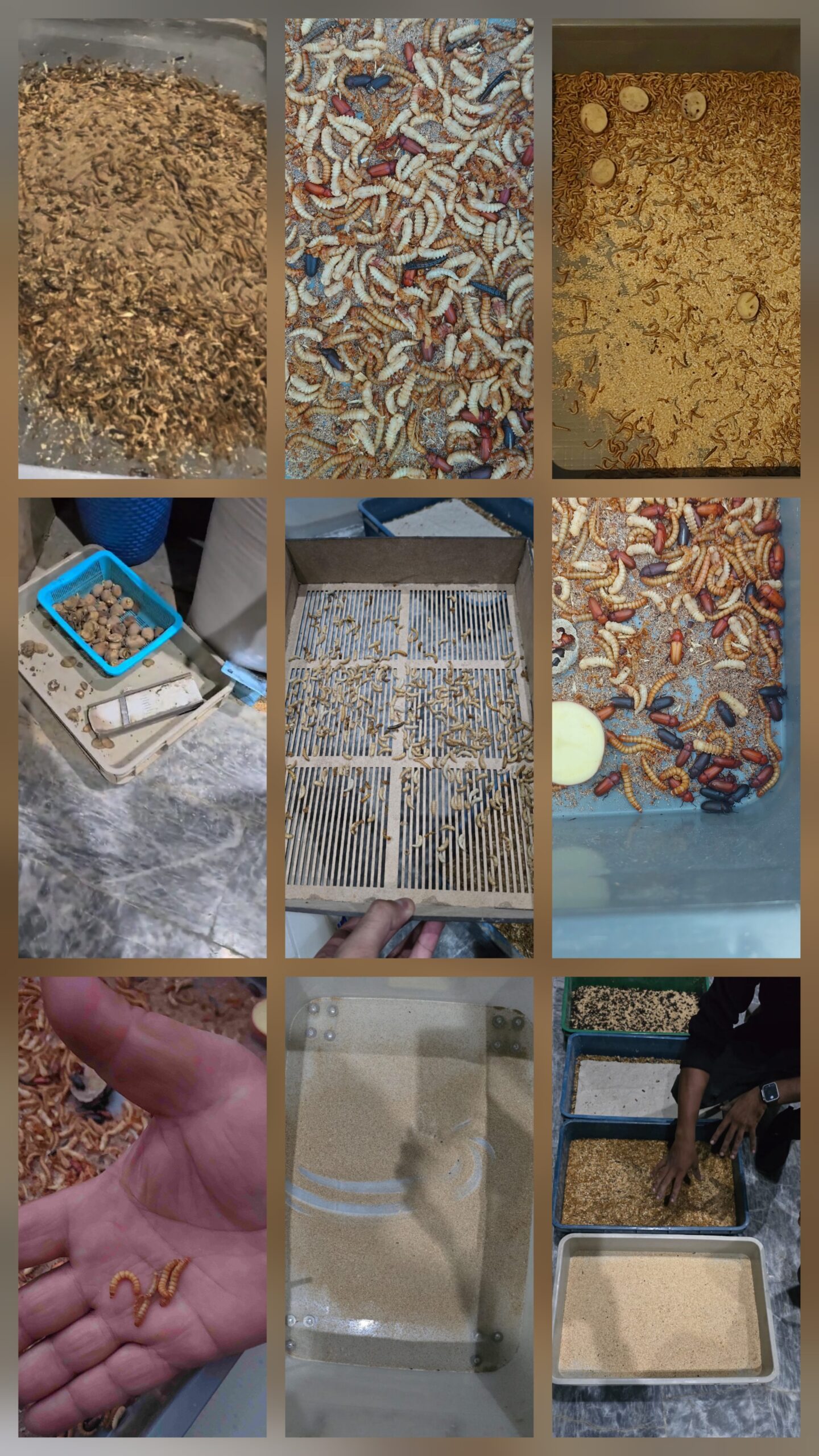
I remember the early days: setting up a few trays in a corner of the house, mixing bran with vegetable scraps, watching little larvae wriggle; while outside, family members shook their heads. In a “desi world,” especially in a place like Lahore, this was not normal. People called it “useless,” “dirty,” or “just a waste of time.” I sometimes wondered whether I was foolish to spend time on this – maybe I should stick to something “normal.”
I’d be lying if I said those voices didn’t hurt. Late at night I wondered if anyone would ever take it seriously. The feeling was sometimes like carrying a secret project, one that might fail, or get laughed at.
Early Days: Curiosity, Trial & Error, Staying Undeterred
Despite all that doubt, I had a strange confidence: I believed in what I saw under the microscope: larvae growing fast, converting waste into biomass, surviving cycles. I started keeping little notes: feed input, moisture, larval count, mortality. Those notes were more than data, they were proof, evidence that something real was happening, even if people around me couldn’t see it yet.
I learned quickly: feed-to-biomass efficiency matters, but only when managed carefully. Moisture, hygiene, ventilation – all small details made or broke a batch. And that taught me discipline: I treated the project like a serious experiment. I couldn’t just wing it.
Scaling Up: Bringing Farmers Into the Loop & Earning Respect Slowly
As I refined the process in my home setup, I began reaching out to farmers around Chakwal. I was nervous: what if they laughed too? What if they refused to even hear me out? But to my surprise, some agreed; they saw the idea’s potential: low-cost feed, waste conversion, possibility of extra income.
Then I showed them the trays, the healthy larvae, the waste-based substrate, and the care I invested. They didn’t mock. They asked questions. They tried it themselves. And little by little, they started believing.
It was in those farms, under real conditions, heat, dust, variable humidity, that I truly understood the value of what I started. Not just as a hobby, but as a viable system. Watching mealworms survive, grow, and yield under semi-arid conditions of Chakwal felt like vindication, not just of biology, but of conviction and persistence.
I’d now meet some of those early skeptics with photographs, yield weights, survival rates, and substrate cost savings. Their questions turned into curiosity. Their skepticism turned into tentative acceptance.
Why This Matters: Because the World Is Adopting Insect Farming
While in Pakistan this project once felt “weird,” globally the world is moving in the opposite direction: edible insect farming, especially mealworms, is becoming a serious and rapidly growing segment of sustainable agriculture. The global mealworms market, valued at about USD 0.52 billion in 2025, is projected to grow to over USD 3.2 billion by 2034 at a strong CAGR of ~25.8% as demand for sustainable protein sources rises across food, feed, and pet markets.
Insects like mealworms are being processed into flour, protein concentrates and animal feeds – supported by regulatory approvals in major markets such as the EU.
This isn’t fringe anymore. Large insect farms and startups globally are using automation to scale up production; investment in insect protein technologies has surged; and the narrative around insects is shifting from novelty to legitimate, sustainable protein and feed solutions.
What I’ve Learned (More Than Science): About Mindset, Culture & Persistence
Over these 16 months, this project taught me more about people and social context than I expected. Some lessons stand out:
- Belief in the unseen: When no one around believed you, your commitment was tested. But keeping records, treating the project seriously, helped me stay grounded in results rather than opinions.
- Changing perceptions needs time & evidence: Cultural taboos and unfamiliarity are powerful. Many studies on edible insect acceptance show that initial resistance is normal, but visible results, data, photographs, yield outcomes, begin to chip away at skepticism.
- Resilience matters more than convenience: Many times, especially when feed dried up, or a batch failed, I thought about quitting. But consistency, learning from mistakes, and adapting became my strongest tools.
- Respect comes through results, not persuasion: Once farmers saw live larvae, yield numbers, and substrate savings, respect replaced skepticism.
- You might be ahead of your time but that’s okay: Innovation often starts out weird. Over time, the weird becomes familiar.
What Farmers Learned – And What I’ve Learned from Them
Working with farmers changed my perspective even more: many had agricultural waste (grain husks, crop residues, vegetable scraps) that was previously unused. For them, mealworm farming offered a way to convert waste into usable feed and fertilizer without huge investment.
Their acceptance taught me humility. Three reminders stuck:
- Results must be visible and tangible – only that convinces.
- Local conditions vary – each farm is unique and needs adaptation.
- Social proof matters – once a few farmers shared success, others became willing to try.
How I’ve Grown: As a Farmer, Advocate, and Voice
Back in August 2023, this felt like a lonely attempt, a side-project whispered about. But today, after seeing farmers in Chakwal adopt the system, waste being reused, larvae harvested, yields recorded, I see potential. I see a silent shift. I see more farmers now asking me: “How can we start this too?” or “Can you supply larvae or fertilizer for my animals?”
That shift in others reflects my own growth: I’m no longer someone tinkering with strange trays. I’m part of a community of small innovators. I have a story. I have data. I have results. And that matters.
What This Means for the Future – With Realism and Hope
I don’t expect every farmer to accept this overnight. I don’t expect societal norms to change in a day. But I now believe this: if you persist, if you show real results, people will eventually listen.
I envision a network of farms: sharing substrate sources, waste streams, know-how. I imagine farmers using mealworm feed or frass to support their poultry or fields. I see a slow but steady shift, from a side-project to sustainable farming practice.
For me, this 16-month journey wasn’t just about mealworms. It was about stubborn belief in an idea, about not letting doubts hold me back. It was about proving, slowly but surely, that even in a desi world where this meant being “different,” change is possible.